Video credit: KeepingFishSimple
Learning how to breed betta fish sounds simple until you realize that putting a male and female together is not exactly a romantic aquarium date.
Bettas are territorial fish. They can be aggressive, breeding can go badly if the pair is introduced at the wrong time, and a successful spawn can leave you with far more tiny mouths to feed than you originally imagined.
The original Stories of Water guide covered the basic process, including selecting a pair, preparing a breeding tank, conditioning the fish, introducing them carefully, watching the bubble nest, removing the female after spawning, and allowing the male to care for the eggs and early fry.
For 2026, the safer way to approach the hobby is to keep those fundamentals but update the husbandry details. Current breeder guides emphasize separate conditioning, shallow warm water, gentle filtration, careful introductions, live or finely sized fry foods, and a plan for raising or rehoming the juveniles. The University of Florida’s IFAS guidance also notes that captive breeding typically uses a shallow container with floating material for the male’s bubble nest, with the female removed after spawning. Read the University of Florida’s betta culture and breeding guidance.
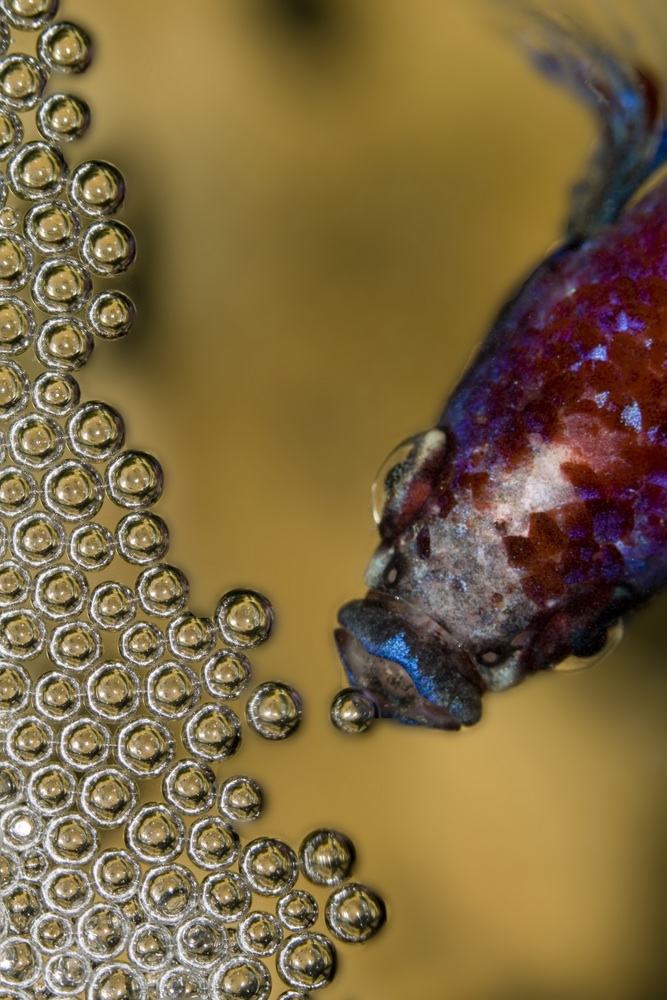
Image credit: Flapper212 via Wikimedia Commons, CC BY-SA 4.0
Is Breeding Betta Fish Really Worth the Work?
For many aquarium hobbyists, absolutely.
Watching a male betta build a bubble nest, seeing the courtship behavior, observing the spawning embrace, and then watching the eggs develop into free-swimming fry can be one of the most fascinating projects in freshwater fishkeeping.
But there is a catch.
Spawning is only the beginning.
A successful breeding attempt can produce dozens or even hundreds of fry. The University of Florida notes that around 300 eggs can be released in a typical spawn, while hobbyist breeding guides warn that large spawns can quickly become a serious grow-out project. That means you need more than a breeding pair. You need tanks, food, time, clean water, and a plan for the young fish.
Before starting, review the Comprehensive Betta Fish Care Guide so both adults are healthy and your general aquarium setup is already under control.
How Betta Fish Reproduce
Betta splendens are bubble-nesting fish. The male creates a floating nest made from small bubbles, usually anchored near the surface under a leaf, floating plant, or another object.
When the female is ready and accepts the male, the pair performs a spawning embrace beneath the nest. Eggs are released and fertilized. The eggs then fall through the water, and the male collects them and places them in the bubble nest.
After spawning, the male usually becomes the egg-and-fry caretaker. He retrieves fallen eggs, repairs the nest, and keeps watch over the developing young.
That sounds surprisingly responsible for a fish whose reputation is basically “tiny aquatic gladiator.”
Aqueon’s current betta care guide also describes male bettas building bubble nests and tending eggs until the young hatch. See Aqueon’s current betta care information.
Step 1: Choose a Healthy Male and Female Betta
The quality of the breeding pair matters enormously.
Look for fish that are active, eating normally, free from obvious disease, and in good physical condition. Avoid fish with severe fin damage, obvious parasites, persistent lethargy, or unexplained swelling.
For a first project, a healthy adult pair from a reputable breeder is generally easier to evaluate than randomly combining two fish and hoping for the best.
What Should a Breeding Female Look Like?
A receptive female may show a visible ovipositor and, depending on her coloration and condition, vertical breeding bars when responding to the male.
Behavior matters just as much. A female that constantly flees, remains severely stressed, or shows no interest is not a candidate you should force into the same tank.
Wikimedia Commons has several documented images of female Betta splendens that are useful when learning the general appearance of females.
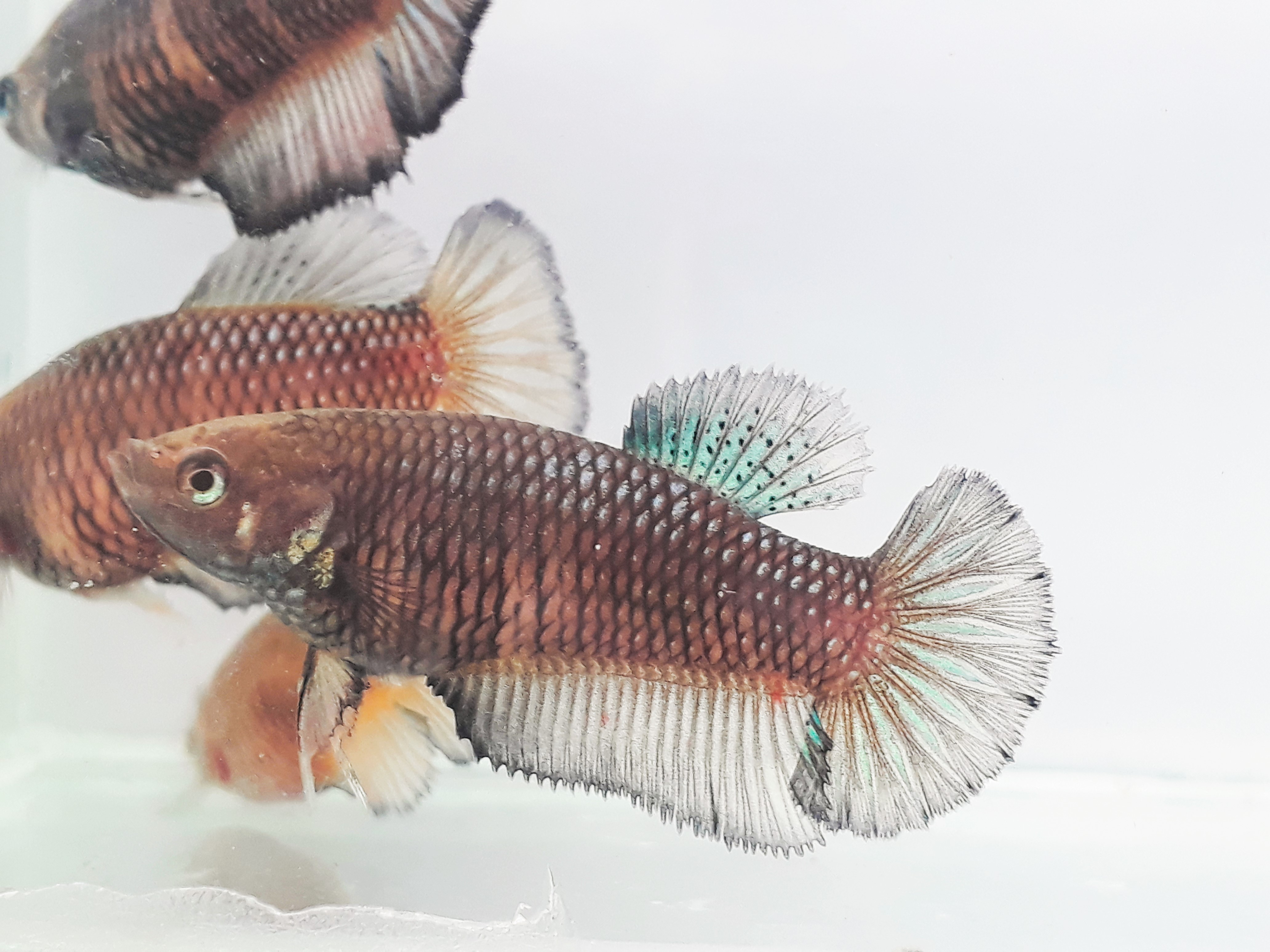
Image credit: BETTAS ZERO via Wikimedia Commons, CC BY-SA 4.0
Step 2: Condition Both Bettas Before Breeding
Do not buy two bettas on Monday and expect a perfect spawn on Tuesday.
Give the fish time to settle into their environments and condition them before introduction.
Current 2026 breeding guides commonly recommend roughly 10 to 14 days of conditioning with nutritious foods. Live or frozen foods such as brine shrimp, daphnia, and bloodworms are often used to improve overall nutritional condition before spawning.
The goal is not to stuff the fish until they look like little footballs. Feed appropriately and remove uneaten food so water quality stays excellent.
The original Stories of Water guide recommends live foods such as bloodworms and brine shrimp and also mentions frozen alternatives. That basic advice still makes sense, but today’s emphasis should be on clean food sources and careful portion control.
If your bettas are new arrivals, use proper acclimation rather than dropping them straight into a breeding setup. The Stories of Water fish acclimation guide explains several approaches for reducing transport stress.
Step 3: Prepare a Dedicated Betta Breeding Tank
A dedicated breeding tank is much easier to manage than trying to breed bettas in a community aquarium.
Current breeder recommendations commonly fall around 20–40 liters for a breeding setup, although successful breeders use different tank sizes and methods. The key features are more important than chasing one magical number.
You want:
- Shallow water.
- Stable warm temperature.
- Very gentle or temporarily reduced water movement.
- Easy observation.
- A secure lid.
- Floating material or another nest anchor.
- Hiding places for the female.
The original guide suggested a 5–10 gallon tank and 5–6 inches of water. That is still a reasonable starting framework for a hobbyist breeding tank, but many contemporary guides favor a shallower setup so newly hatched fry can reach the surface easily.
For the broader aquarium environment, the best plants for betta fish guide can help when choosing soft, safe plant material for shelter and cover.
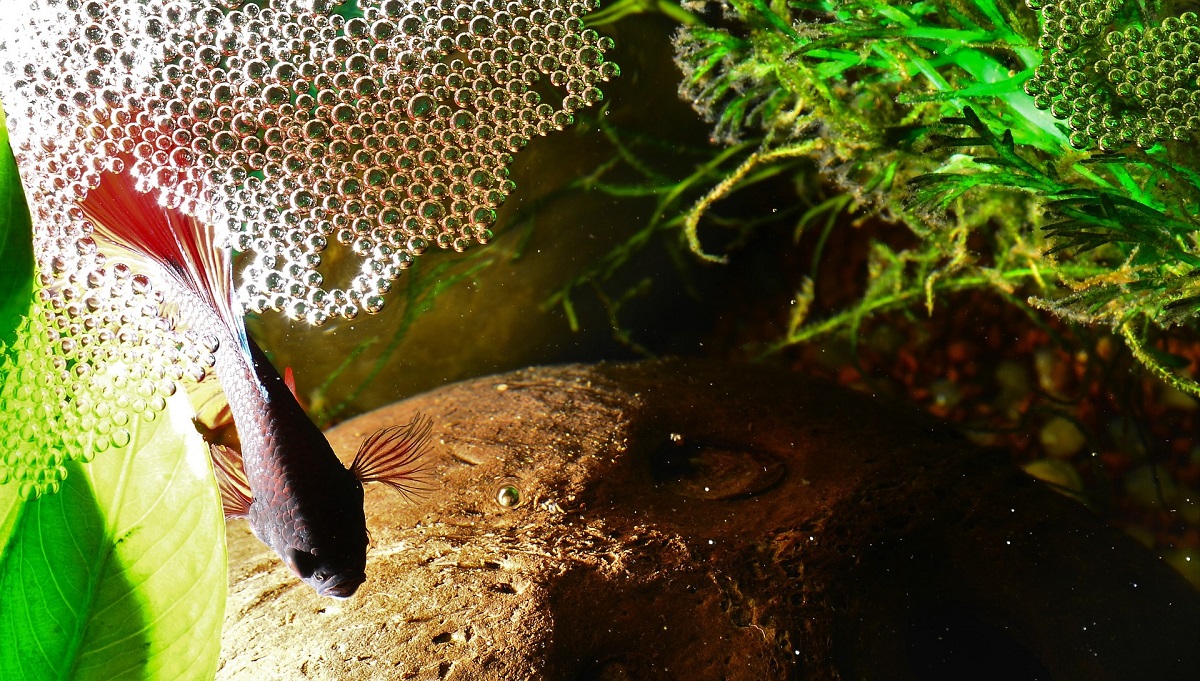
Image credit: The Shrimp Farm
Step 4: Keep the Water Warm and Stable
Temperature stability matters during breeding.
A practical target used in many current breeding setups is roughly 78–82°F (25.5–27.8°C), with some breeders choosing the upper portion of that range during spawning.
The exact temperature is less important than avoiding sudden swings. A stable heater and a reliable thermometer are much better than repeatedly guessing with your finger.
The latest Stories of Water aquarium heater guide can help you choose equipment for maintaining consistent tropical-water temperatures.
Also remember that the breeding tank is not an excuse to ignore water quality. Ammonia and nitrite should remain at zero, while nitrate should be kept low through appropriate maintenance.
For practical water-maintenance ideas, see how to change betta fish water.
Step 5: Add a Nest Anchor
Male bettas can build bubble nests in many locations, but giving the nest a stable surface can make the process easier for both the fish and the breeder.
Floating plants are popular. A small piece of floating material can also work as long as it is clean and aquarium-safe.
Why does this matter?
Because thousands of tiny bubbles moving around the tank isn’t exactly an engineering masterpiece. The male needs a relatively calm surface where the nest can hold together.
Keep water movement gentle. Strong surface agitation can break apart the bubble nest and make the male repeatedly start over.

Image credit: Antonio Rojo via Wikimedia Commons, CC BY-SA 3.0
Step 6: Let the Male See the Female Before Releasing Her
This is one of the most important parts of betta fish breeding for beginners.
Do not simply toss the female into the male’s territory and walk away to make coffee.
Instead, let them see one another while remaining physically separated. A transparent divider or suitable container can allow visual contact without immediate fighting.
The male may flare his fins. The female may display breeding bars or show interest. Some chasing and posturing can be part of courtship, but excessive aggression is a red flag.
If one fish is relentlessly attacking the other, stop.
Breeding is not supposed to be a test of which fish has the better wrestling record.
Recent breeder guidance strongly emphasizes slowing down the introduction because premature pairing can result in serious injury to the female.
Step 7: Introduce the Female Carefully
Once the male has built a suitable nest and the female appears receptive, you can consider allowing direct contact.
Stay nearby.
Watch continuously.
The female needs somewhere to retreat if the male becomes too aggressive. Plants, floating cover, or other safe hiding structures can provide valuable escape space.
Do not confuse normal courtship behavior with uncontrolled fighting.
A little flaring can be normal.
Persistent biting and severe chasing are different.
When in doubt, separate them.

Image credit: ZooFari via Wikimedia Commons, CC BY-SA 3.0
Step 8: Watch for the Betta Spawning Embrace
When courtship succeeds, the pair moves beneath the bubble nest.
The male wraps around the female while eggs are released. The fish may repeat the embrace several times before most of the eggs are deposited.
At this point, the male begins collecting the falling eggs and placing them into the nest.
This is one of the coolest moments in the entire process. It is also the moment when you should resist the temptation to put your hands into the tank every thirty seconds.
Watch.
Observe.
Take photographs from outside the tank.
Let the fish do what they know how to do.
Step 9: Remove the Female After Spawning
Once spawning is complete and the female is no longer needed, remove her carefully and return her to a suitable recovery tank.
Why?
Because the male’s priorities change dramatically once eggs are in the nest. He becomes strongly territorial and may chase the female away or injure her.
The female may also eat some of the eggs.
The University of Florida specifically recommends removing the female after spawning, while modern breeder guides emphasize the same step.
The important detail is timing: don’t remove her simply because you’ve seen one embrace. Wait until spawning is actually finished.
Image credit: Flapper212 via Wikimedia Commons, CC BY-SA 4.0
Step 10: Let the Male Care for the Eggs
Now the male becomes the nursery manager.
He may pick up eggs that fall from the nest and return them. He may add bubbles. He may hover beneath the nest and keep watch.
Don’t destroy the nest by rearranging the aquarium.
Don’t remove every bubble because you think the surface looks messy.
And don’t assume a male standing beneath the nest is “doing nothing.” He is doing exactly what you want him to do.
Eggs commonly hatch within around 24–48 hours, depending on temperature and conditions. The young initially remain in or below the nest while they consume their yolk reserves.
A gentle setup matters here. Stories of Water’s fish-tank cleaning guide is useful for understanding how to maintain water quality without turning aquarium maintenance into a demolition project.
What Do Betta Fry Look Like?
At first, betta fry barely look like fish.
They are tiny.
They may hang vertically beneath the bubble nest and twitch as they develop.
Then comes the exciting moment: free swimming.
Once the fry are swimming horizontally around the tank instead of hanging in the nest, the breeding phase is effectively over and the grow-out phase begins.

Image credit: ZooFari via Wikimedia Commons, CC BY 3.0
When Should You Remove the Male?
This is a common beginner question.
The answer is usually tied to free-swimming behavior.
During the egg and very early larval stages, the male’s care is valuable. Once the fry are swimming freely, many breeders remove the male and move the young into their grow-out routine.
One commonly used timeline is approximately Day 3–5 for free swimming and male removal, though individual spawns can vary.
Do not obsess over the calendar to the point that you ignore what the fish are actually doing.
Watch the fry.
Behavior is more useful than blindly following a number on a chart.
What Should You Feed Betta Fry?
This is where many first-time breeders discover that tiny fish require surprisingly tiny meals.
Newly free-swimming fry have very small mouths. They cannot simply eat the same pellets you feed adult bettas.
Common first foods include:
- Infusoria or other very small live foods.
- Microworms.
- Suitable commercial fry foods.
- Baby brine shrimp as the fry grow and can handle them.
The University of Florida recommends initial live foods such as infusoria and brine shrimp nauplii, followed by appropriately sized prepared foods as the fish grow. See the University of Florida’s detailed culture guidance.
The original Stories of Water article correctly warns breeders to prepare fry food before spawning. Do not wait until 100 fry are swimming around to ask yourself, “Where exactly do I buy microworms?”

Image credit: Antonio Rojo via Wikimedia Commons, CC BY-SA 3.0
How Often Should Betta Fry Be Fed?
Young fry have small stomachs and high energy demands, so breeders commonly feed small portions frequently rather than offering one giant meal.
The exact schedule depends on the food, fry age, temperature, population density, and breeder setup.
There is one universal rule worth remembering:
Don’t overfeed a fry tank just because the fry are tiny.
Uneaten food can quickly pollute a small aquarium. Tiny fish plus deteriorating food is not the chemistry experiment anyone asked for.
Feed carefully, observe consumption, and maintain excellent water quality.
How to Maintain Water Quality During Fry Growth
This is where the work really starts.
Fry produce waste. Food produces waste. Dense populations magnify the problem.
Once the fry are established, many breeders use frequent small water changes rather than waiting for the water to become obviously dirty.
Always match replacement water temperature as closely as practical and use appropriately conditioned water.
If you are unsure about your normal betta water routine, revisit Betta Fish Water: How to Maintain Clean Aquarium Water.
For a broader planted setup, the current Stories of Water aquarium plant guide is another useful resource.
Should You Use a Filter in a Betta Breeding Tank?
Filtration requires some thought during breeding.
A strong current can damage the bubble nest, exhaust the adults, and create problems for tiny fry. That is why breeders often rely on very gentle filtration, such as a properly adjusted sponge filter, especially once fry are present.
During the earliest stages, some breeders temporarily reduce filtration or leave it off while the male is caring for eggs, provided they have a controlled system and understand the water-quality risks.
There is no good reason to let the water become stagnant and unsafe simply to protect a bubble nest.
Balance is the goal.
The Stories of Water aquarium air-pump guide can help you understand the equipment used to create controlled aeration and water movement.
How Big Should the Grow-Out Tank Be?
That depends largely on how many fry survive.
And this is where the “cute little breeding project” can suddenly become a full-time aquarium management hobby.
A single spawn can produce far more juveniles than a typical community aquarium can comfortably house long-term.
As the fish grow, water volume, filtration, feeding, and maintenance requirements increase. Many experienced breeders eventually separate or “jar” juvenile males because adult male bettas become increasingly territorial.
Before breeding, decide what you will do with excess juveniles.
Can you sell them?
Can you responsibly rehome them?
Do you have enough space?
If the answer is no, reconsider the breeding project before you start.
Common Betta Breeding Mistakes Beginners Make
Putting the Pair Together Too Quickly
This is probably the biggest avoidable mistake. Let them see each other first and look for signs of readiness.
Using a Deep Tank
Very deep water can make it harder for the early fry to reach the surface. Shallow breeding setups are commonly preferred.
Creating Too Much Water Movement
A powerful filter can destroy the bubble nest and exhaust the fish.
Skipping Conditioning
A poorly conditioned pair may be less prepared for spawning and recovery.
Not Preparing Fry Food
This is like having a baby arrive and then starting to search for a grocery store.
Leaving the Female With the Male After Spawning
Once spawning is complete, the male may become intensely territorial. Remove the female promptly and carefully.
Overfeeding the Fry
More food does not automatically mean faster growth. Dirty water can become a much bigger problem.
Do You Need Live Plants for Betta Breeding?
No, but plants can be very helpful.
Floating or soft plants can provide cover, give the bubble nest an anchor, and make the breeding tank feel more natural.
Just avoid anything sharp, rough, or chemically questionable.
For examples and care ideas, visit the Stories of Water best plants for betta fish guide.
You can also use artificial or silk plants if they are aquarium-safe and have smooth surfaces. The goal is function, not winning an underwater interior-design competition.

Image credit: Damien Perrotin via Wikimedia Commons, CC BY 2.5 / CC BY-SA 3.0
Can You Breed Bettas in a Community Aquarium?
It is generally a poor idea for intentional breeding.
Bettas are territorial, eggs and fry are vulnerable, and other fish can interfere with spawning or eat the young.
A dedicated breeding tank gives you far more control over the pair, nest, water depth, temperature, food, and fry.
For general tank setup principles, the Comprehensive Betta Fish Care Guide covers filtration, tank size, heating, water parameters, and enrichment.
How Long Does Betta Fish Breeding Take?
The overall process is faster than many people expect, but growing the fry to healthy juveniles takes considerably longer.
A rough hobbyist timeline can look like this:
- 10–14 days: condition the breeding pair.
- Day 0: spawning and fertilized eggs.
- About 1–2 days: eggs hatch.
- About Days 3–5: fry become free-swimming.
- After free swimming: begin focused grow-out feeding and maintenance.
- Following weeks: rapid growth, repeated water management, and increasing space requirements.
These times are approximate. Temperature, fish condition, genetics, and individual spawning behavior can change the pace.
What Happens to the Fry After the First Week?
The fry gradually become more recognizable as miniature fish.
They begin swimming more strongly, eating larger foods, and exploring more of the tank.
At this point, the biggest challenge is no longer getting them to hatch.
It’s keeping a growing population healthy.
That means clean water, appropriate feeding, enough space, and careful observation.

Image credit: ZooFari via Wikimedia Commons, CC BY 3.0
What About Separating Young Male Bettas?
Eventually, male juveniles may become territorial toward each other.
That can create a major space problem for breeders.
Experienced breeders often use individual containers for young males once aggression becomes significant, although the exact timing varies with the fish and the breeder’s goals.
This is one reason the number of fry matters so much.
Breeding 20 fish is very different from breeding 150.
Plan your future space before your first bubble nest appears.
How to Keep a Breeding Tank Clean Without Destroying the Fry
Maintenance needs to be gentle.
Use careful siphoning and protect the fry from being accidentally sucked out. Some breeders cover the intake of a siphon or use a fine mesh barrier to reduce risk.
Work slowly.
Watch the water you’re removing.
And don’t completely dismantle the tank every time you perform maintenance.
The same principle applies to filtration. Clean or maintain filter media according to the setup while preserving the biological filtration your system depends on.
For a refresher on aquarium cleaning, see How to Clean a Used Fish Tank Safely.
For larger systems, Stories of Water’s SunSun Canister Filter review can also help you understand how larger filtration systems work, although a canister filter is usually not the first choice for a delicate fry setup.
Is Betta Breeding Cruel?
Intentional breeding can be responsible when it is planned around the welfare of the fish.
The problem comes when breeding is treated like a quick experiment: pair fish, get eggs, and hope everything works out.
A responsible breeder should be prepared to separate aggressive fish, treat injuries appropriately, maintain good water quality, provide suitable food, and find suitable homes for excess juveniles.
Don’t breed simply because baby bettas look adorable.
They do look adorable.
That’s precisely the trap.
Adorable today can become 100 hungry fish next month.
What Makes a Successful Betta Breeding Setup?
There is no single secret ingredient.
Successful betta breeding is more like putting together a good recipe. The individual ingredients matter, but the timing matters too.
You need:
- A healthy, compatible pair.
- Proper conditioning.
- A stable breeding tank.
- Warm, clean water.
- A calm surface for the bubble nest.
- Safe introduction and close supervision.
- Careful female removal after spawning.
- Appropriate egg and fry care.
- Correct first foods.
- A realistic grow-out and rehoming plan.
Miss one of those and the whole project can become much harder.
How to Improve Your Chances of a Successful Spawn in 2026
Keep your approach boring.
Yes, boring.
Stable temperature. Stable water. Clean tank. Good food. Careful observation.
Fish breeding does not need constant tinkering.
The temptation to keep changing things is strong. New food! New plant! New water! New decoration! New filter! New idea from a forum!
Stop.
If the fish are healthy and conditions are stable, simplicity often wins.
Modern breeding guides from 2026 consistently emphasize preparation and observation over rushing the process. The current TankZen betta breeding guide is another recent resource that covers tank setup, conditioning, bubble nests, egg care, and fry development.
Final Thoughts: How to Breed Betta Fish Successfully
Learning how to breed betta fish is not difficult because the concept is complicated. It is difficult because the details matter.
Start with healthy fish.
Condition them properly.
Prepare a separate, shallow, warm breeding aquarium.
Let the male and female see each other before direct contact.
Watch their behavior carefully.
Once spawning happens, give the male room to care for the eggs, then remove the female when spawning is finished.
When the fry hatch, don’t panic because they look like tiny commas with eyes.
That’s normal.
Feed them appropriately, maintain excellent water quality, and watch for the transition to free swimming.
Then comes the part many beginners underestimate: raising all those youngsters.
The original Stories of Water guide was right about one thing that still matters in 2026—betta fish breeding takes time, attention, resources, and commitment.
It can also be incredibly rewarding.
There is something special about watching a male carefully tend a bubble nest, then seeing tiny fry emerge beneath it. What starts as a handful of bubbles can eventually become an entire generation of colorful bettas.
Just make sure you’re ready for the plot twist.
The hardest part of breeding bettas isn’t getting babies. It’s raising them well.
And that is exactly where patience, preparation, and good fishkeeping make all the difference.