Video credit: Bulk Reef Supply – Saltwater Aquariums
Setting up a saltwater aquarium is exciting. You have the tank. You have the rock. The sand is ready. The saltwater looks fantastic. Maybe you’ve already picked out the clownfish you’ve been dreaming about.
Then someone tells you to wait.
Wait?
But the tank is full!
Welcome to the nitrogen cycle—the invisible process that turns a brand-new saltwater aquarium into a much safer home for fish and other marine life.
Learning how to cycle a saltwater aquarium is one of the most important things a new reef keeper can do. The original Stories of Water guide explained four traditional cycling methods. For 2026, the big change is how hobbyists approach those methods: fishless cycling is generally the preferred starting point, while carefully managed bacterial seeding, live rock, and established biological media can help establish the biofilter more efficiently.
Current saltwater-aquarium guidance from Bulk Reef Supply also emphasizes the same core sequence: ammonia rises, beneficial bacteria process it into nitrite, then another group of bacteria processes nitrite into nitrate. The goal is to establish enough biological filtration to handle the waste your livestock will produce.

Image credit: Nano-Reef Community
What Does “Cycling” a Saltwater Aquarium Actually Mean?
In simple terms, cycling a saltwater aquarium means growing the beneficial microorganisms that process fish waste.
Fish release ammonia through their waste and gills. Uneaten food and decaying organic matter can also contribute ammonia.
Ammonia is dangerous to aquarium inhabitants. Luckily, helpful microorganisms begin converting it into nitrite. Then another group of microorganisms converts nitrite into nitrate.
Nitrate is far less toxic than ammonia and nitrite, but it is not something you simply ignore forever. It accumulates and is managed through water changes, nutrient export, macroalgae, refugiums, and other methods depending on the aquarium.
So think of your biological filter as a tiny sanitation department.
Ammonia arrives at the front door.
The bacteria process it.
The waste gets transformed.
And suddenly your aquarium has its own microscopic cleanup crew.
The modern best saltwater test kit guide is a useful companion because regular testing is what tells you whether that invisible workforce is actually developing.
Why Is Cycling a Saltwater Tank So Important?
A new aquarium may look beautiful while being biologically unprepared.
That crystal-clear water can be deceptive.
It may look like bottled perfection, but the bacteria that process waste have not necessarily established themselves in sufficient numbers. Add a fish too quickly and ammonia can rise faster than the developing biofilter can handle.
Current aquarium guidance recommends establishing the biological filtration before heavily stocking a new marine tank. A recent 2026 beginner’s guide from Bulk Reef Supply explains that cycling is about developing biological filtration capable of processing ammonia into less harmful compounds.
That’s why cycling a new saltwater aquarium is not a pointless waiting game.
It is preparation.
It is basically hiring your cleanup crew before opening the restaurant.
The Three Main Stages of the Saltwater Nitrogen Cycle
Stage 1: Ammonia Appears
The cycle starts when an ammonia source enters the aquarium.
During a fishless cycle, this can come from a measured ammonia solution or another controlled ammonia source. Traditional methods also used decomposing fish food or raw seafood.
The important part is that you know what is being added and can test the result.
Stage 2: Ammonia Becomes Nitrite
Ammonia-oxidizing microorganisms establish themselves and begin processing ammonia into nitrite.
As this happens, ammonia starts falling and nitrite begins rising.
That rising nitrite reading is not a failure.
It is evidence that part of the biological process is getting established.
Stage 3: Nitrite Becomes Nitrate
Another group of microorganisms processes nitrite into nitrate.
Eventually, both ammonia and nitrite should return to zero or undetectable levels on your chosen test kit, while nitrate becomes measurable.
The exact pattern varies from aquarium to aquarium, so don’t panic if your graph doesn’t look like a perfectly symmetrical science textbook illustration.

Image credit: Reef2Reef community
How Long Does It Take to Cycle a Saltwater Aquarium in 2026?
This is the question every new aquarist wants answered.
“How many days until I can add my fish?”
Unfortunately, there is no universal countdown clock.
A cycle can take around a week in some carefully controlled setups using established biological media or effective bottled bacteria products, while other systems take several weeks or longer. Naturally establishing a nitrifying population can take considerably longer.
DrTim’s fishless cycling guidance notes that naturally establishing nitrifying bacteria can take 30–45 days and that saltwater systems can take longer. At the other end of the spectrum, current hobbyist methods using established media and bacterial products can significantly shorten the process.
So don’t set your phone reminder for “Fish Day: Tuesday.”
Let your test results make the decision.
The 2026 Bulk Reef Supply cycling guide recommends watching the actual ammonia, nitrite, and nitrate progression rather than relying only on a fixed number of days.
Fishless Cycling: The Best Starting Point for Most New Tanks
If you’re starting from scratch, fishless cycling is usually the cleanest and most controlled approach.
Why expose a live fish to potentially dangerous ammonia and nitrite when you can establish the bacteria first?
You can’t make the process instant, but you can make it more predictable.
A modern fishless cycle generally involves four broad steps:
- Set up the entire aquarium and get the equipment running.
- Add a controlled ammonia source.
- Allow beneficial bacteria to establish and monitor ammonia and nitrite.
- Confirm the tank can process the ammonia load before adding livestock.
The Stories of Water reverse osmosis system guide is useful here because many saltwater keepers use purified RO/DI water when mixing new seawater and replacing evaporation.
Step 1: Set Up the Saltwater Aquarium Completely
Before starting the cycle, finish the physical setup.
Add your rock.
Add your chosen sand.
Prepare saltwater to the appropriate salinity for your planned livestock.
Install the heater and filtration.
Start circulation.
Make sure everything works.
This is the stage where you want to discover that the return pump makes an unpleasant noise—not three weeks later when your aquarium is full of fish.
Current beginner guidance recommends getting the basic rock, sand, water, filtration, and heating decisions sorted before moving into the cycling phase.
For substrate ideas, take a look at the updated best aquarium sand guide.
Step 2: Choose the Right Saltwater
Use a quality marine salt mix and mix it according to the manufacturer’s instructions.
Do not assume that “salt” means ordinary table salt.
Marine salt mixes contain a broader collection of major and minor elements designed to recreate seawater chemistry.
The original Stories of Water article on the best reef salt compares several salt mixes and explains the difference between marine salt mixes and ordinary aquarium salt.
Most importantly, choose a salt mix that fits your planned aquarium and then try to keep your mixing process consistent.

Image credit: Jellyfish Art / API Fishcare
Step 3: Add an Ammonia Source
This is the part where fishless cycling differs from simply filling an aquarium and waiting.
The bacteria need a food source.
For a controlled fishless cycle, many aquarists use a measured ammonium chloride solution or another known ammonia source. This allows you to control the amount rather than guessing how much ammonia a handful of fish food will eventually produce.
DrTim’s fishless cycling guidance specifically uses an ammonia source along with nitrifying bacteria and test kits.
Do not blindly copy a dosing recipe from a random forum post.
Follow the instructions for the particular ammonia product you’re using and test regularly.
Step 4: Seed the Tank With Beneficial Bacteria
This is where modern saltwater cycling gets interesting.
You do not necessarily have to wait for bacteria to slowly arrive from nowhere.
There are several ways to introduce beneficial microorganisms:
- Live rock.
- Established biological media.
- Live sand.
- Commercial bottled bacterial products.
Bulk Reef Supply’s current guidance discusses bacterial boosters such as Dr. Tim’s One & Only, Brightwell MicroBacter Start, and MicroBacter7 as options used to seed new aquariums.
That doesn’t mean every bottle produces identical results in every aquarium. Product instructions, storage conditions, temperature, salinity, and the amount of ammonia in the tank all matter.
Still, bacterial inoculation can dramatically improve the starting point.
Live Rock vs Dry Rock for Cycling
Your rock choice can influence how you approach cycling.
Wet live rock can arrive with an established community of microorganisms. It can help accelerate biological establishment, but it may also bring unwanted algae, pests, or hitchhikers.
Dry rock begins much cleaner. It offers excellent control over what enters your aquarium, but the biological population has to develop after the rock is placed in the system.
The current 2026 Bulk Reef Supply rock and sand guide explains the trade-offs between wet live rock and dry rock and how both can be used successfully.
There is no single winner.
It’s more like choosing between a furnished apartment and an empty house.
The furnished place is ready sooner, but you don’t fully control what the previous tenant left behind.
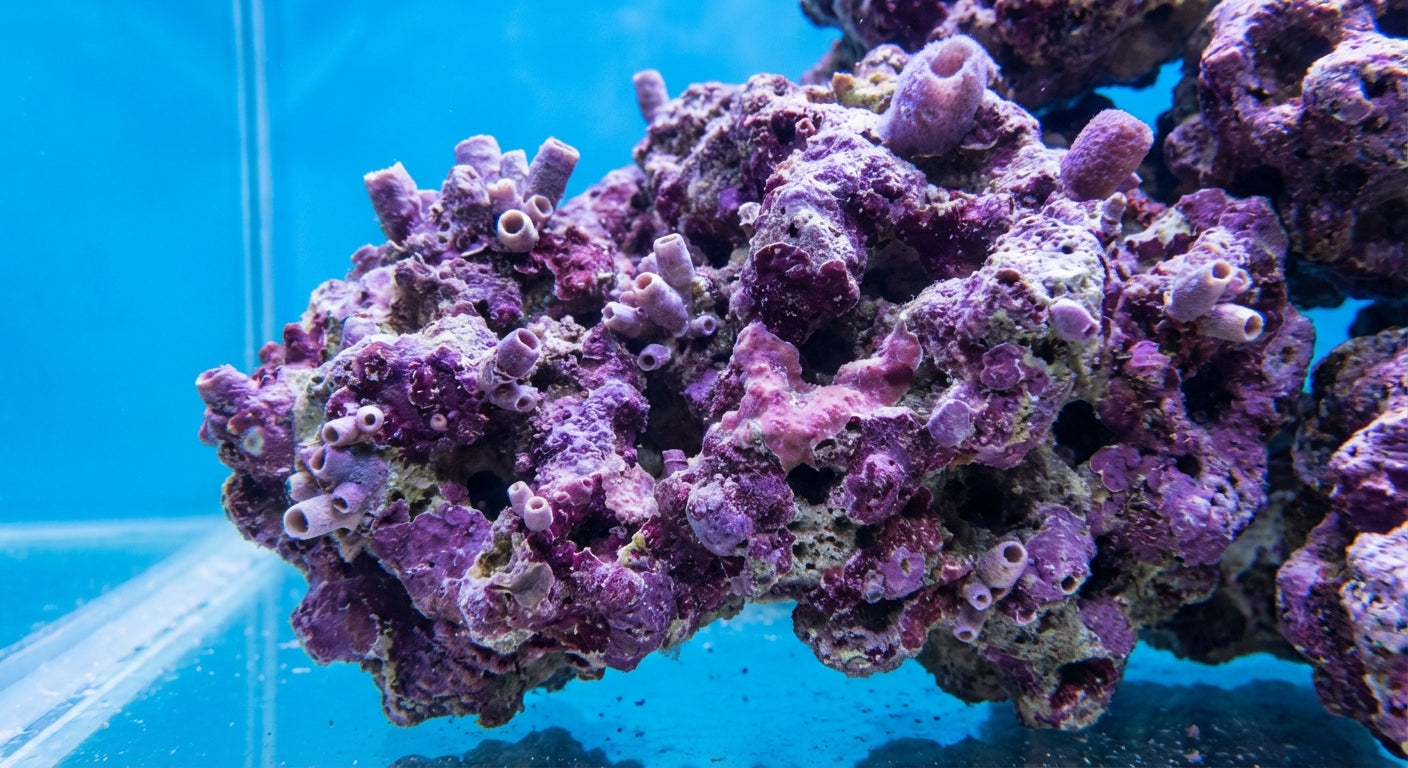
Image credit: CoralMastery
Step 5: Run the Equipment During the Cycle
Generally, the biological filtration should be operating during the cycle.
That means circulation, heating, and appropriate filtration should be running so the developing bacteria experience conditions similar to the environment they’ll have once fish arrive.
Temperature matters.
Oxygen matters.
Water movement matters.
Stability matters.
Your developing bacterial community does not appreciate daily environmental mood swings.
Use a reliable thermometer and keep the temperature appropriate for the marine livestock you intend to keep. The Stories of Water best aquarium heaters guide is a practical reference when choosing heating equipment.
Should You Turn the Aquarium Lights On During Cycling?
Not necessarily.
For many new reef aquariums, keeping display lighting limited during the initial cycle can help avoid encouraging nuisance algae before the system has matured.
That does not mean light is somehow “bad” for cycling.
It simply means you may not want to provide a giant buffet to every opportunistic algae species before your aquarium has developed a more balanced ecosystem.
Bulk Reef Supply’s cycling guidance also recommends limiting aquarium lighting during early cycling and initial stocking to help manage nuisance algae.
How Often Should You Test a Saltwater Aquarium During Cycling?
This is where your test kit earns its keep.
During the initial cycle, focus primarily on:
- Ammonia
- Nitrite
- Nitrate
For a brand-new aquarium, testing every couple of days can help you understand the progression. As you become familiar with the pattern, you can adjust the schedule to match the method you’re using.
Record the readings.
Seriously.
Write them down.
A tiny spreadsheet can be more useful than trying to remember whether ammonia was 1 ppm or 2 ppm four days ago.
The API Saltwater Master Test Kit currently tests high-range pH, ammonia, nitrite, and nitrate, making this type of monitoring straightforward for a new setup.
What Does a Normal Cycling Pattern Look Like?
Typically, you’ll see a sequence something like this:
Ammonia rises → ammonia falls → nitrite rises → nitrite falls → nitrate rises.
That pattern is the basic story of your developing biofilter.
You might see ammonia drop very quickly in one aquarium and linger for much longer in another.
Likewise, your nitrite peak may be dramatic or barely visible depending on the testing schedule and cycling method.
Don’t judge the cycle based on one test.
Look for the trend.
That’s a much better indicator.
How Do You Know When a Saltwater Aquarium Is Fully Cycled?
This is where many beginners make a mistake.
They see nitrate.
They celebrate.
They add fish.
Then ammonia rises.
Why?
Because detecting nitrate alone doesn’t prove that the aquarium can process a meaningful ammonia load quickly enough.
A stronger confirmation is to add a controlled ammonia dose appropriate to your chosen fishless cycling method and verify that the tank can bring ammonia and nitrite back to zero within the expected test window.
DrTim’s fishless cycling guidance uses the ability to convert the ammonia challenge without measurable nitrite within 24 hours as a confirmation method.
Other current guides use slightly different confirmation criteria, so follow the cycling method’s instructions and interpret the complete trend rather than relying on one number.
What Should Your Ammonia and Nitrite Readings Be Before Adding Fish?
For a new fish-only or reef aquarium, you generally want ammonia and nitrite at zero or undetectable levels before adding livestock.
Nitrate can be present.
In fact, nitrate appearing during the cycle is often part of the expected process.
The key is to manage it afterward rather than pretending it doesn’t exist.
API’s current saltwater testing guidance identifies ammonia, nitrite, nitrate, and high-range pH as important marine-water parameters to monitor.
What About the Old “Hardy Fish” Cycling Method?
The original Stories of Water article included cycling with hardy fish.
That method was once widely discussed in aquarium circles.
But in 2026, there is a much stronger reason to avoid making it your first choice: the fish are exposed to the ammonia and nitrite generated while the biofilter is developing.
Modern fishless methods let you establish the biological filter without intentionally subjecting livestock to that initial toxic period.
A properly planned fishless cycle is therefore the approach we’d recommend for most new hobbyists.
What About Cycling With Fish Food?
Fish food is another traditional method.
You add a small amount, allow it to break down, and let the decomposing material generate ammonia.
It can work.
But the downside is control.
Exactly how much ammonia will that food generate?
How quickly will it break down?
How much leftover organic material will remain?
That uncertainty makes measured ammonia dosing more attractive for many modern aquarists.
Fish food can still be useful in certain setups, especially when following a method designed around it, but it is not necessarily the cleanest or easiest option for a beginner.
Can You Cycle a Saltwater Aquarium With an Established Filter?
Yes.
Established biological media from a healthy, disease-free aquarium can carry a valuable bacterial population.
This is one of the fastest ways to give a new system a biological head start.
But there is a major warning:
Only transfer established media from a trustworthy aquarium.
You don’t want to “seed” your new reef with beneficial bacteria plus an unwanted outbreak, parasite, pest, or medication residue.
The principle is simple: you’re importing an ecosystem, not just a sponge.

Image credit: Bulk Reef Supply
What Is the Fastest Way to Cycle a Saltwater Aquarium?
If speed matters, the most sensible route is usually some combination of:
- Good-quality biological media or suitable live rock.
- A reputable nitrifying bacteria product.
- A controlled ammonia source.
- Stable temperature and oxygenation.
- Frequent testing.
Even then, don’t chase the word fast so aggressively that you stop testing.
A tank does not become safe because a bottle says “instant.”
Your test results are what matter.
Some current cycling products and established-media approaches can shorten the process significantly, but the speed depends on the specific setup and whether enough bacteria are actually present and functioning.
Why Does a Saltwater Tank Sometimes Get “Stuck”?
You may see ammonia stop falling.
Or nitrite may stay high for what feels like forever.
Don’t immediately assume your bacteria have disappeared.
There are several possible reasons:
- The ammonia dose was too large.
- pH has fallen too low.
- The tank lacks enough bacterial surface area.
- The bacterial product was damaged or improperly stored.
- Testing is being performed incorrectly.
- The ammonia source is being added too aggressively.
DrTim’s fishless cycling guidance specifically warns against repeatedly adding ammonia every day and recommends keeping pH from falling below 7 during its method.
A recent 2026 Reef Rookies guide also discusses stalled cycles and the importance of bringing extreme ammonia or nitrite levels back into a range the bacterial population can tolerate.
Should You Do Water Changes During the Cycle?
It depends on what is happening.
You don’t necessarily need to perform large routine water changes simply because the cycle is underway.
However, a water change can be useful when ammonia or other conditions become excessive, when contaminants enter the system, or when your chosen cycling method specifically recommends one.
Once the cycle is complete, water changes become part of your normal nutrient-management routine.
That’s where the Stories of Water aquarium cleaning guide can help establish a good maintenance habit.
What Happens After the Cycle Is Complete?
This is another area where patience pays.
A completed initial cycle does not mean your aquarium is biologically finished forever.
Think of it as graduation day—not retirement.
When you add fish, the waste load increases. The biological population needs to adjust to the new demand.
That’s why gradual stocking is important.
Current reef guidance recommends adding livestock slowly so the biofilter has time to catch up.
Avoid going from “zero fish” to “I bought the entire store’s clownfish section.”
That is a very effective way to turn a successful cycle into an ammonia problem.
Image credit: Lowrance
Should You Add Corals Immediately After Cycling?
Not necessarily.
A reef aquarium can be chemically cycled while still being biologically immature.
New tanks often experience what reef keepers call the “ugly stage,” when diatoms, algae, bacterial films, and other organisms take advantage of the young system.
That does not automatically mean your aquarium has failed.
It means the ecosystem is developing.
The current brown algae guide explains why new aquariums commonly encounter diatoms and how nutrient and silicate management can influence them.
Does a Protein Skimmer Help During Cycling?
A protein skimmer is useful equipment in many marine aquariums, especially reef systems, but it does not replace the nitrogen cycle.
A skimmer removes certain dissolved and particulate organic compounds before they fully break down into additional nutrients.
It is part of the overall filtration strategy.
It is not a substitute for nitrifying bacteria.
The Stories of Water protein skimmer guide explains how these systems work and why they can be valuable in marine aquariums.
Do You Need a Sump for Cycling?
No.
A sump can be extremely useful, especially on larger reef aquariums, because it provides space for filtration equipment, heaters, skimmers, reactors, and additional biological media.
But a sump is not what creates the nitrogen cycle.
Your beneficial microorganisms need suitable surfaces and stable conditions, whether those surfaces are in live rock, sand, biological media, or other filtration components.
For larger marine systems, the Stories of Water canister filter guide can also help you understand the role of external filtration, although reef tank filtration choices should match the specific livestock and system design.
What About Nitrate After Cycling?
Nitrate is where the story continues.
After ammonia and nitrite are being processed efficiently, nitrate can accumulate.
How you manage nitrate depends on the aquarium.
Common tools include:
- Regular water changes.
- Macroalgae and refugiums.
- Appropriate feeding.
- Protein skimming.
- Biological nutrient-management methods.
Don’t chase zero nitrate simply because zero sounds nice.
Marine organisms need nutrients, and the appropriate range depends on the livestock and style of aquarium you’re maintaining.
How to Avoid a Mini-Cycle After Adding Fish
A common mistake is assuming that once the tank is cycled, you can add several fish at once.
Not a great idea.
Your existing biofilter developed according to the waste load it experienced during cycling. A sudden increase in livestock can temporarily overwhelm that bacterial population.
Instead:
- Add livestock gradually.
- Feed sensibly.
- Monitor ammonia after stocking changes.
- Avoid introducing a huge biological load overnight.
This is one reason a slow stocking plan is much less stressful than trying to build the entire reef in one weekend.
How to Cycle a Saltwater Aquarium Without Killing Fish
Here’s the simplest modern answer:
Don’t use fish as the ammonia source when you can cycle the aquarium without them.
A fishless cycle lets you establish the biological filter first and then introduce livestock after testing confirms that the system is ready.
It’s more humane, easier to control, and easier to troubleshoot.
The old fish-in method may still appear in older aquarium articles, but it is no longer the method we’d choose as the default for a new marine aquarium.
Saltwater Aquarium Cycling Checklist for Beginners
Before you begin, make sure you have the basics ready:
- Fully assembled aquarium.
- Marine salt mix.
- Reliable heater and thermometer.
- Water movement and filtration.
- Rock and suitable biological media.
- Ammonia source for fishless cycling.
- Ammonia, nitrite, and nitrate tests.
- RO/DI water or another appropriate purified-water source.
- Containers for preparing replacement saltwater.
- A notebook or spreadsheet for test results.
Having everything prepared before adding ammonia saves a lot of frustration later.
And yes, write down the test results.
Your future self will thank you.
Common Saltwater Cycling Mistakes to Avoid
Adding Fish Too Early
Clear water is not proof of a completed nitrogen cycle.
Overdosing Ammonia
More ammonia does not automatically mean more bacteria. Excessively high concentrations can make the process harder rather than faster.
Adding Ammonia Every Day
Some fishless cycling methods require repeated additions, but others do not. Follow the specific protocol rather than improvising.
Ignoring pH
A significant pH decline can interfere with nitrification. This is particularly important during a prolonged fishless cycle.
Testing Only Once
One reading is a snapshot. Several readings create the story.
Adding Too Many Fish at Once
Even a successfully cycled aquarium needs time to adjust to a larger biological load.
What Is the Best Saltwater Aquarium Cycling Method in 2026?
For most beginners, our preferred approach is a fishless cycle using a controlled ammonia source plus an appropriate bacterial starter or established biological media.
It provides control.
It protects livestock from the worst part of the initial cycle.
And it gives you measurable results that are easier to interpret.
Live rock or established media can provide an additional biological advantage, provided the source is trustworthy and appropriate for your aquarium.
Fish-in cycling can be done, but it is not the option we’d put at the top of a beginner’s list when safer fishless alternatives are available.
Final Thoughts: Don’t Rush the Saltwater Aquarium Cycle
Learning how to cycle a saltwater aquarium is really about understanding one simple truth: the most important workers in your aquarium are too small to see.
You won’t watch them build anything.
You won’t hear them working.
You won’t get a notification saying, “Congratulations! Your bacteria have arrived.”
Instead, you watch the test results.
Ammonia rises.
Nitrite follows.
Nitrate appears.
Then ammonia and nitrite return to zero as the biological filter becomes capable of processing the waste load.
That is the moment when your aquarium starts behaving less like a glass box full of water and more like a functioning ecosystem.
The original Stories of Water article outlined four traditional ways to cycle a saltwater aquarium. For today’s hobbyist, the most sensible upgrade is to put fishless cycling, controlled ammonia dosing, bacterial seeding, careful testing, and gradual stocking at the center of the process.
And don’t be discouraged by the waiting.
Every day your tank cycles, you’re building something you can’t see.
That invisible biological foundation is what will eventually make it possible to enjoy the colorful fish, corals, invertebrates, and reef life you’ve been imagining since you first decided, “Yep, I definitely need a saltwater aquarium.”
So let the bacteria do their thing.
Test the water.
Trust the numbers.
And when the tank is genuinely ready, add your first fish slowly.
Your reef doesn’t need you to hurry. It needs you to get it right.